Battery Performance Test for Handheld Vacuums
Battery run-time and charge cycle are the ultimate benchmark for handheld devices. Let’s look at how ShouldIT puts handheld vacuums to the test.
This test is part of How ShouldIT Tests Handheld Vacuum Cleaners v1.0
With modern cordless design, handheld vacuum cleaners have become more versatile than ever before. Evaluating the performance of cordless vacuums naturally involves the performance of their batteries because of how the appliance is meant to be used.
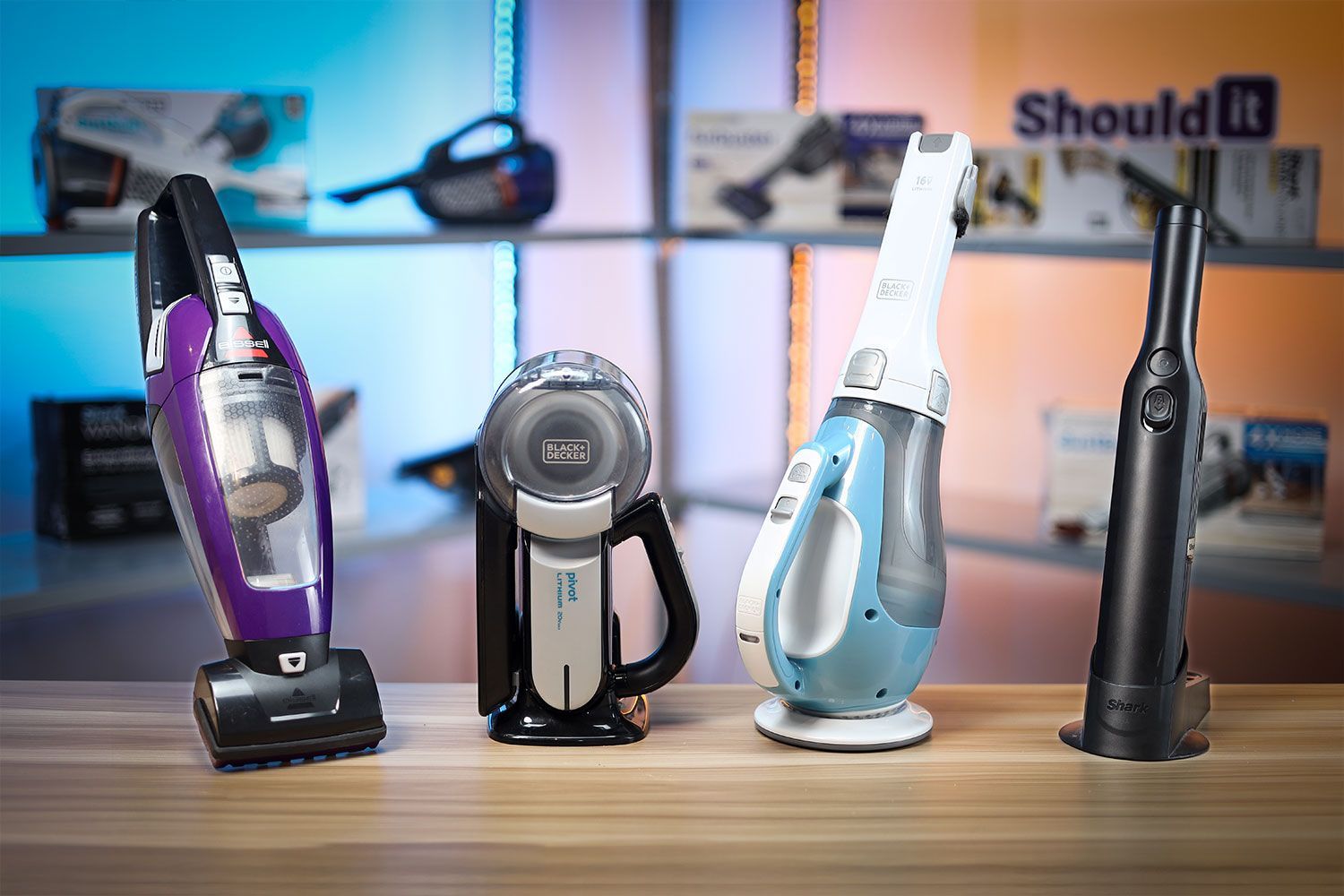
This particular test has two steps: Quick Charging (30%), which looks at charging in 5-minute intervals, and Max Runtime (70%), which is self-explanatory. We choose to highlight these aspects in our assessment as they reflect real-life use most accurately, which helps us make the best and well-informed recommendations.
Preparing for the test
Essentially, all units need to be fully charged prior to each of the two steps of the test. All units are plugged into the same power strip with an off/on switch. After that, we proceed with the test.
Equipment we use for this test includes:
- Cordless handheld vacuum cleaners
- Timer
- Power strip with switch
How we test
As mentioned before, here we’re evaluating for quick charging capability and maximum runtime of each vacuum. We design our test so that all the units are in the same conditions and start from the same starting point:
Step 1: Quick Charging
After the vacuum cleaners have been fully charged, we turn them on simultaneously and let them run for 5 minutes. We use the standard speed for all units.
After 5 minutes, we turn the cleaners off, reset the timer, and turn on the power strip to charge all units at the same time. From here, we monitor the charging process and time the cycles for each unit.
Step 1 lets us know how long they take to fully charge up after a quick 5-minute pickup.
Step 2: Max Runtime
With all the vacuums fully charged coming out of the first step, we continue to time for the maximum using time of each one. Here, we turn them on and let them run, then time them during the process.
Step 2 lets us know how long they can operate from a full charge.
How we score
Max Runtime (70%)
Typically, it takes less than half an hour to vacuum an average-size room, even less time in a car. Very few models on the market are able to push for the 30-minute mark, that's why it's a critical threshold to measure to.
For Max Runtime, the products are evaluated as follows:
- A product scores 10 out of 10 points if it stops no sooner than 30 minutes.
- For every 4 minutes sooner, it loses 1 point.
In other words, 26 minutes equals 9 points, 22 minutes equals 8 points, 18 minutes equals 7 points, and so on. This also translates to 0.25 points for every minute sooner than 30.
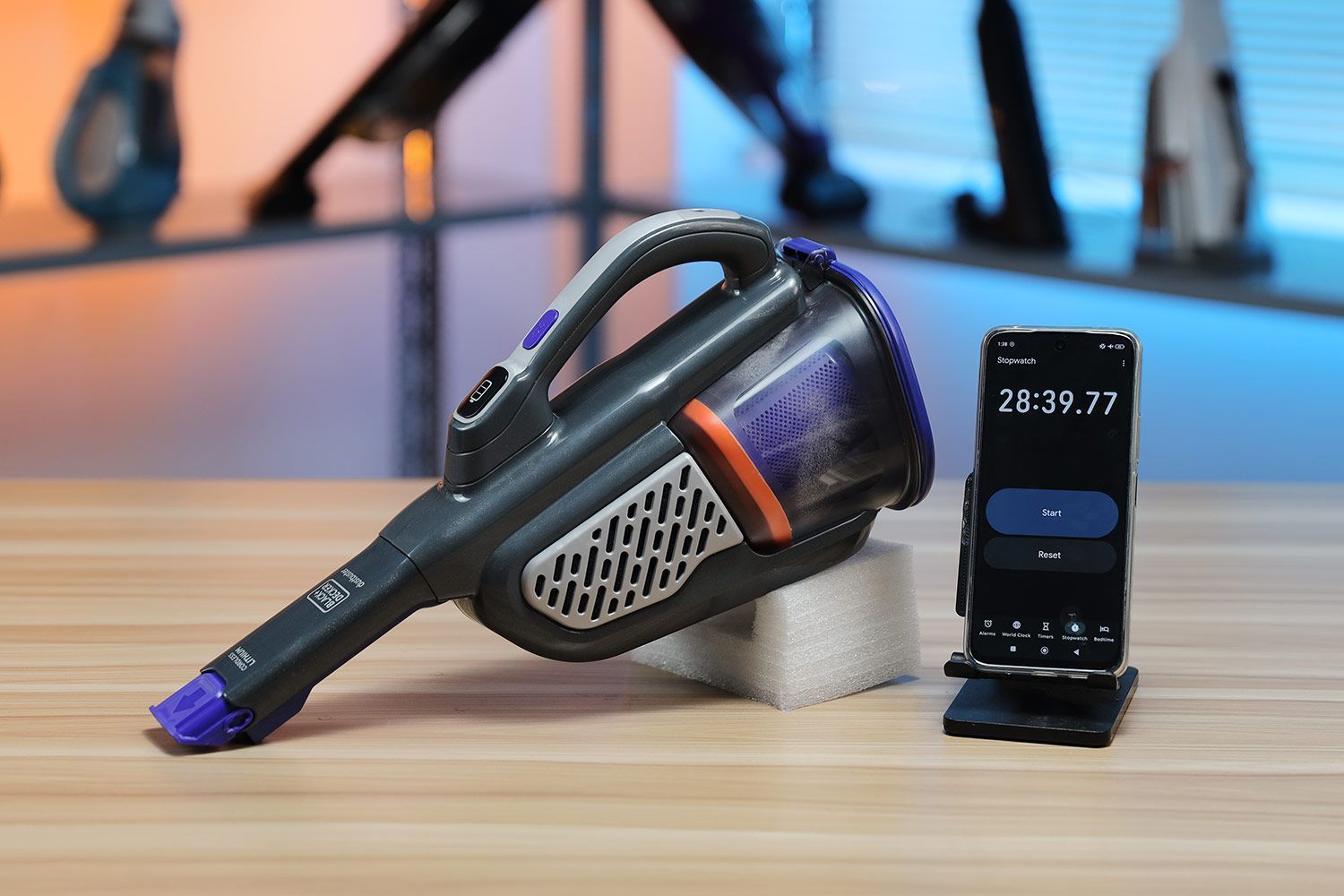
For example, the Black+Decker Advanced Pet records at 28 minutes 40 seconds. That means the vacuum loses 0.25 points for the 1 minute and 20 seconds, and scores a 9.75 for this segment.
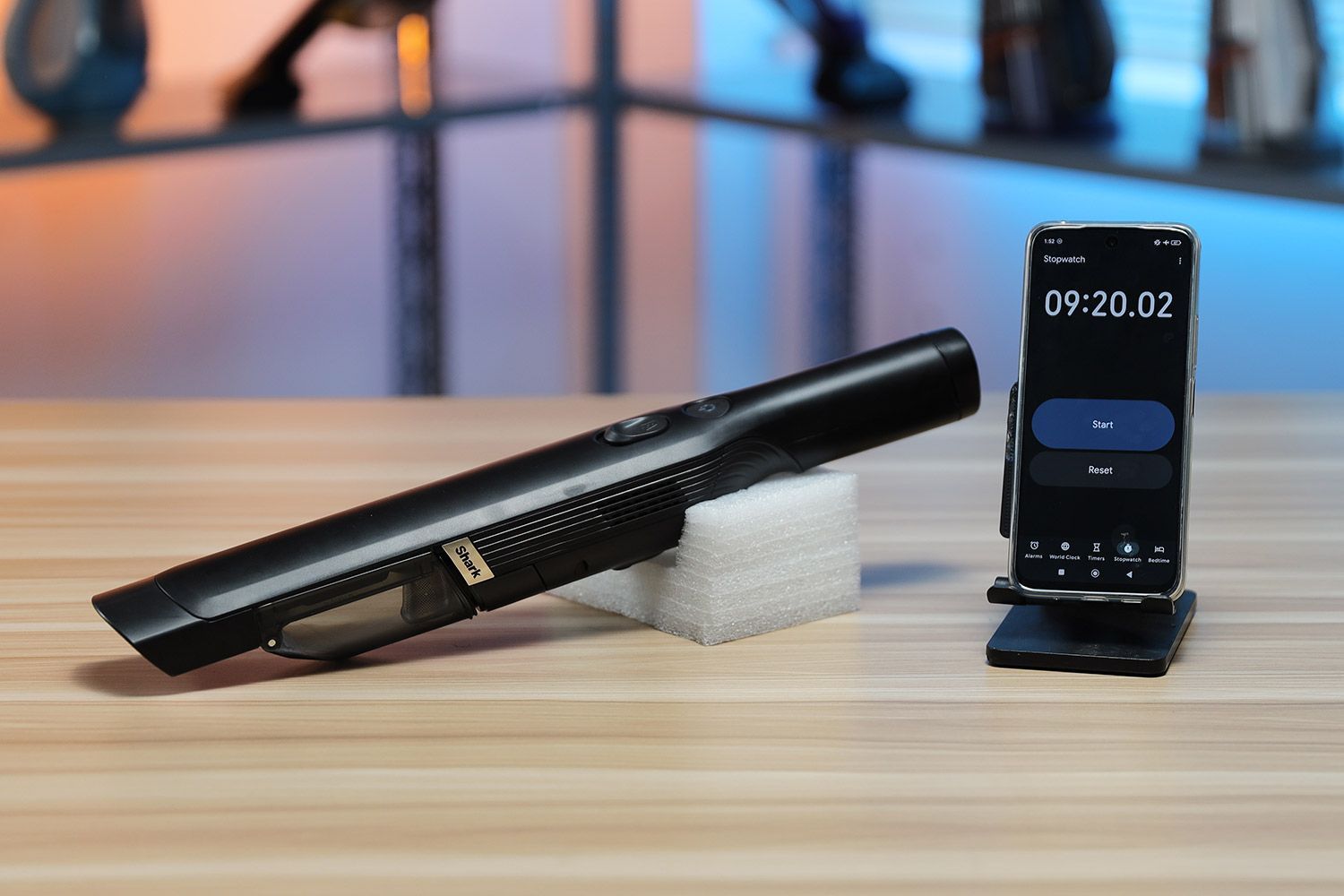
Take the Shark HandVac for another example. For the recorded 9 minutes and 20 seconds, it loses 5 points for the 20 minutes and 40 seconds and scores only 5 points for the chart.
Quick Charging (30%)
It's essential that a handheld vacuum is quick to charge up after a quick cleanup session. And we feel that anything less than an hour of charging time for some 5-minute vacuuming is absolutely perfect.
With that in mind, Quick Charging is scored as follows:
- A product scores 10 out of 10 points if it takes less than 1 hour.
- For every 15 minutes longer, it loses 1 point.
For example, the Black+Decker Advanced Pet scores a perfect 10 because it takes only 49 minutes to charge up after running for 5 minutes, or the Shark Ultra Pet scores the same points because it does so in 1 hour. By contrast, the Bissell Pet scores only 4 points due to taking as long as 2 hours 30 minutes to finish the task.