Our recommendations are made independently. We may receive commissions from purchases made via our links.
Cooking Oil Test for Infrared Thermometers
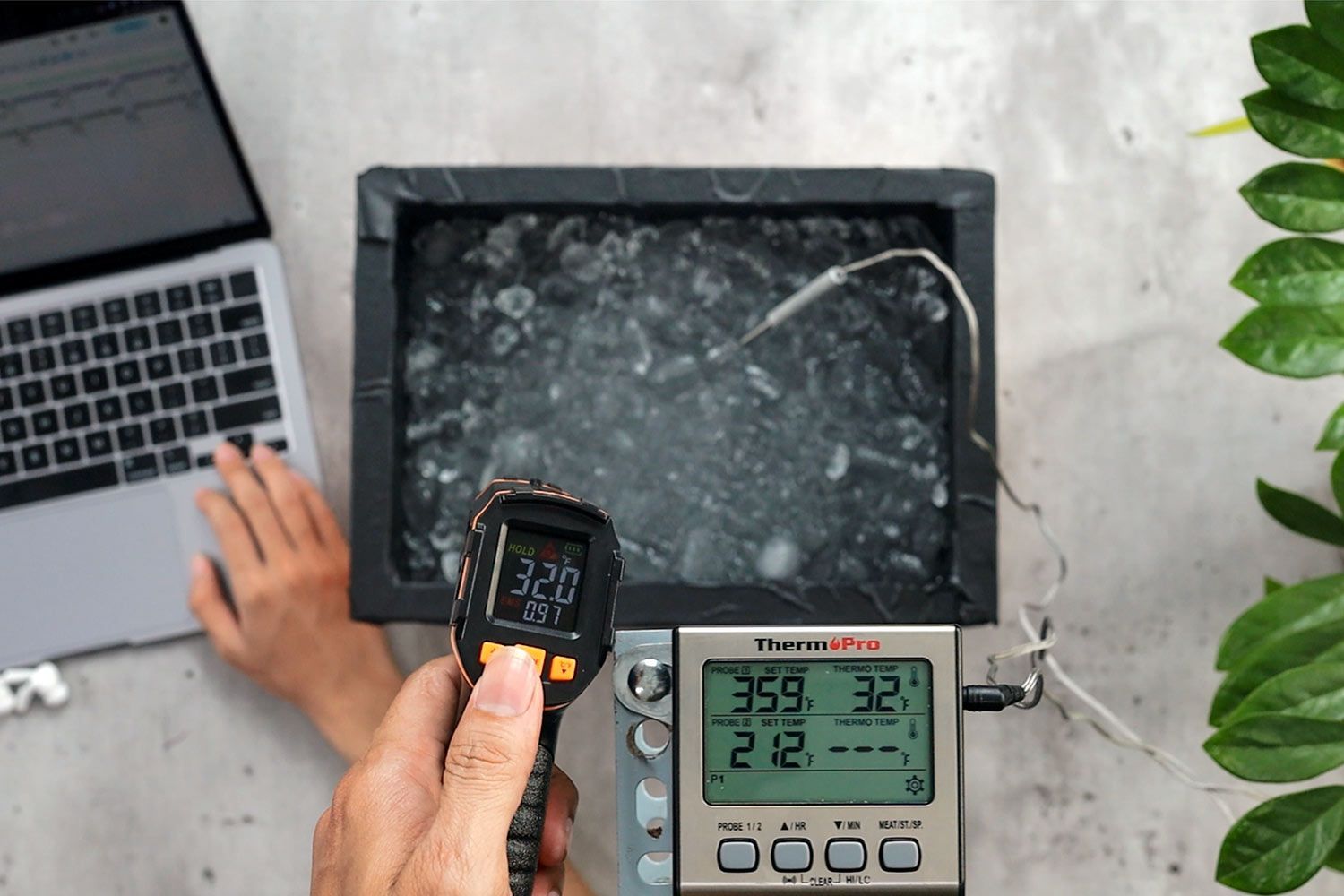
In the kitchen, next to a temperature probe, an IR thermometer is the next best way to measure oil temperature for cooking, which is exactly what this test is meant to represent!
This test is part of How Shouldit Tests Infrared Thermometers v1.1
One of the most common applications of an IR thermometer is to measure the cooking oil temperature for frying and cooking. We replicate the exact condition for this test to determine how accurate each model is at estimating the oil temperature.
A temperature probe is used as a reference for the measurement. The closer each IR thermometer gets to the value of the temperature probe, the higher it’ll score in our test.
How We Prepare the Cooking Oil for Testing
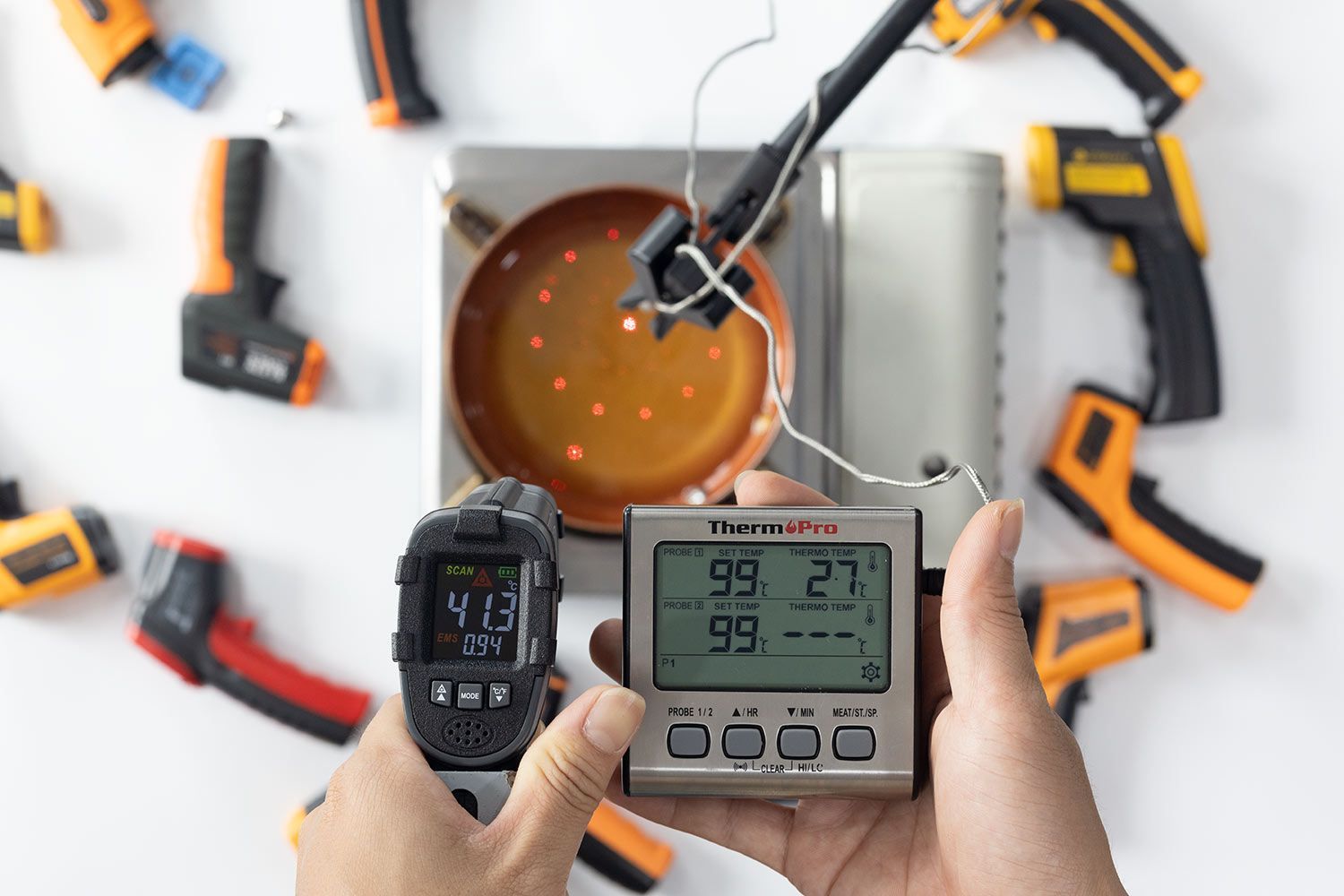
We use vegetable oil for this test, which should have a boiling point of around 572°F (300°C). However, we don’t bring the oil to that temperature out of safety concerns. The oil only got to the typical frying temperature of around 360°F.
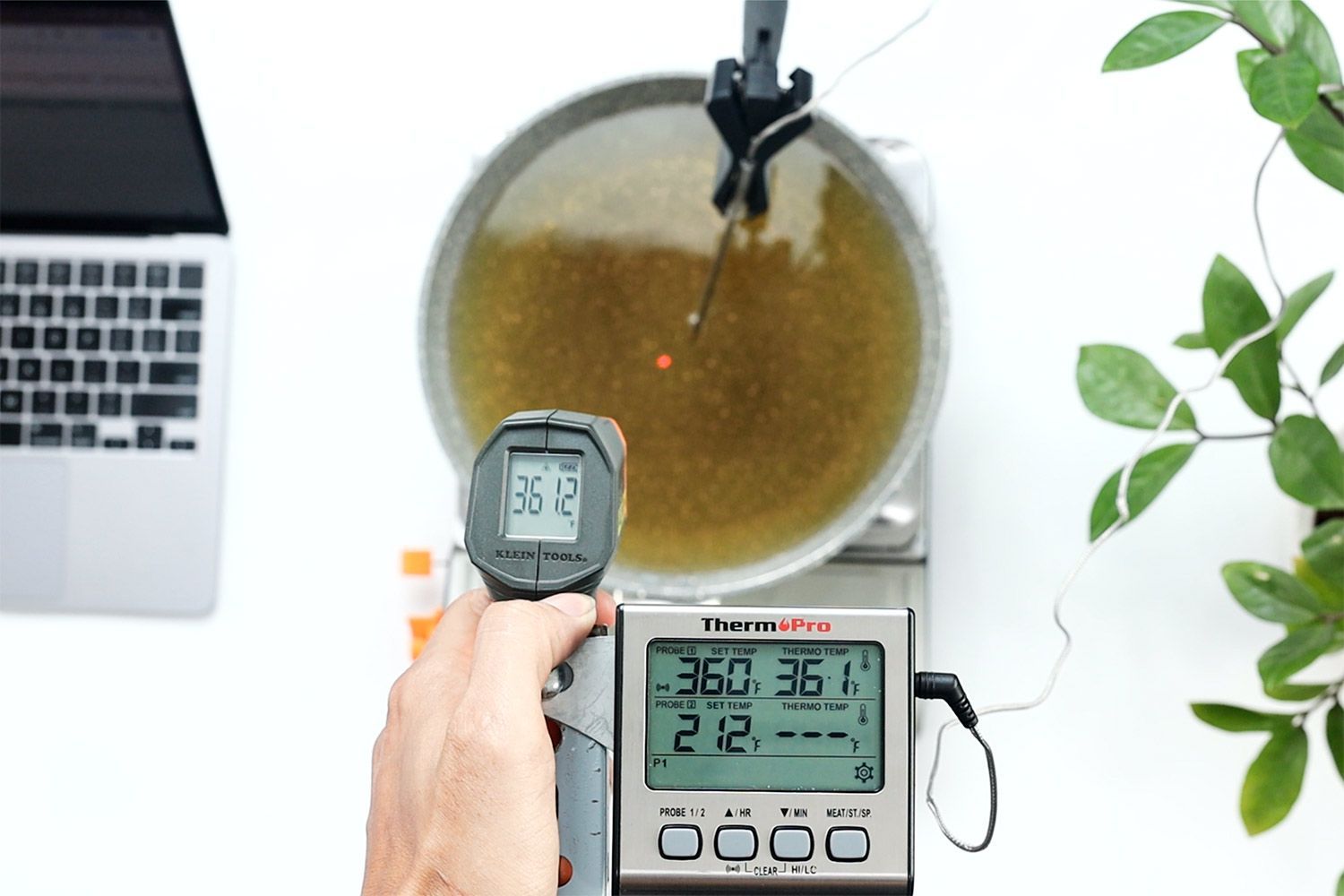
Vegetable oil is poured into a frying pan, then set on top of a mini stovetop. The heat is adjusted to bring the oil to 361°F (monitored by a temperature probe), then carefully reset to keep the oil temperature static.
Once the oil temperature has stabilized, that’s our signal to start the test.
How We Test IR Thermometer Using Cooking Oil
As the oil heats, we take the time to set the EMS setting for all adjustable IR thermometers to 0.94, which is the recommended emissivity setting for cooking oil.
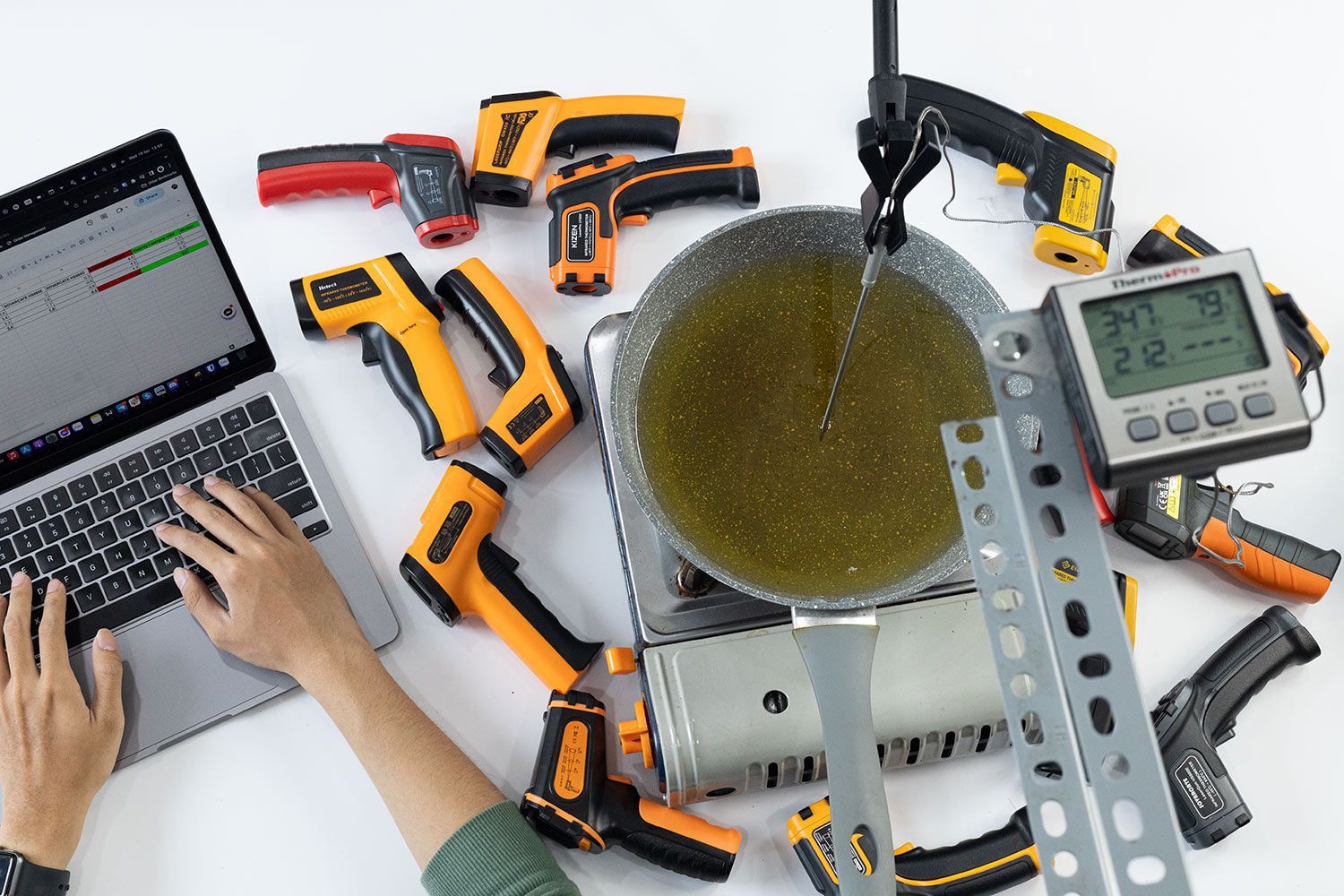
Once the temperature has stabilized at around 361°F and the conditions have been verified by our test lead (Lap Vo), we’ll start putting each IR thermometer to the test.
Two readings are taken: one at a distance of 12 inches from the surface of the cooking oil and another at 16 inches. The distance has already been pre-measured and marked by two metal bars. We only have to brace the thermometer onto the bar and press the trigger to start the measurement.
The thermometer is put into scan mode for 3 seconds; then, the reading is taken and recorded into our database via a laptop.
During the test, the temperature of the oil can fluctuate. When that happens, we momentarily pause the test and adjust the heat until the oil temperature returns to the ideal 361°F (according to the temperature probe we use for reference.)
How We Collect, Analyze, and Score the Test Results
After the test is wrapped up and all of the data has been entered into Shouldit’s database, the team meets to finalize the results and score the performance of each IR thermometer.
For the cooking oil test, the ideal temperature reading that the thermometer should display is 361°F. If the thermometer’s reading is accurate to that of the temperature probe we use as a reference, then it would get a perfect score in this section.
The scoring of the cooking oil test takes up 60% of the total performance score.
But to make the score more accurate, the total score for this section is broken down into two sub-scores.
How We Score
We calculate the overall score for this test using two major figures: the Average score of each IR thermometer, and the Stability Variable score. Overall score is calculated as follows:
Overall Score = Average - Stability Variable
Average Score
We average the two readings at 12 and 16 inches to obtain an average figure, which we’ll then compare to the reference temperature at 361°F. This highlights the accuracy of the devices.
A perfect score of 10 means the average figure stays well within the range of 359-363°F, allowing an error tolerance of 2°F.
From that point, for every 4°F outside the range, 1 point is taken from the average score (0.25 points for every 1°F.)
Stability Variable Score
The other benchmark, Stability Variable, highlights how temperature readings may be affected by a change in distance. A good design should minimize the severity of such an effect.
To evaluate that, we first subtract the readings at 12 inches and 16 inches from one another to calculate the difference. Then, taking into account the error tolerance of 2°F, Stability Variable is scored as follows:
Stability Variable = (difference - 2) x 0.2
In relation to the overall score, this means for every 5°F in difference after the first 2 degrees, 1 point is subtracted from the total (0.2 points for every 1°F.)
Note: The surface area of the oil is well within the D:S (Distance to Spot) ratio of all the IR thermometers in our database.
Case Sample
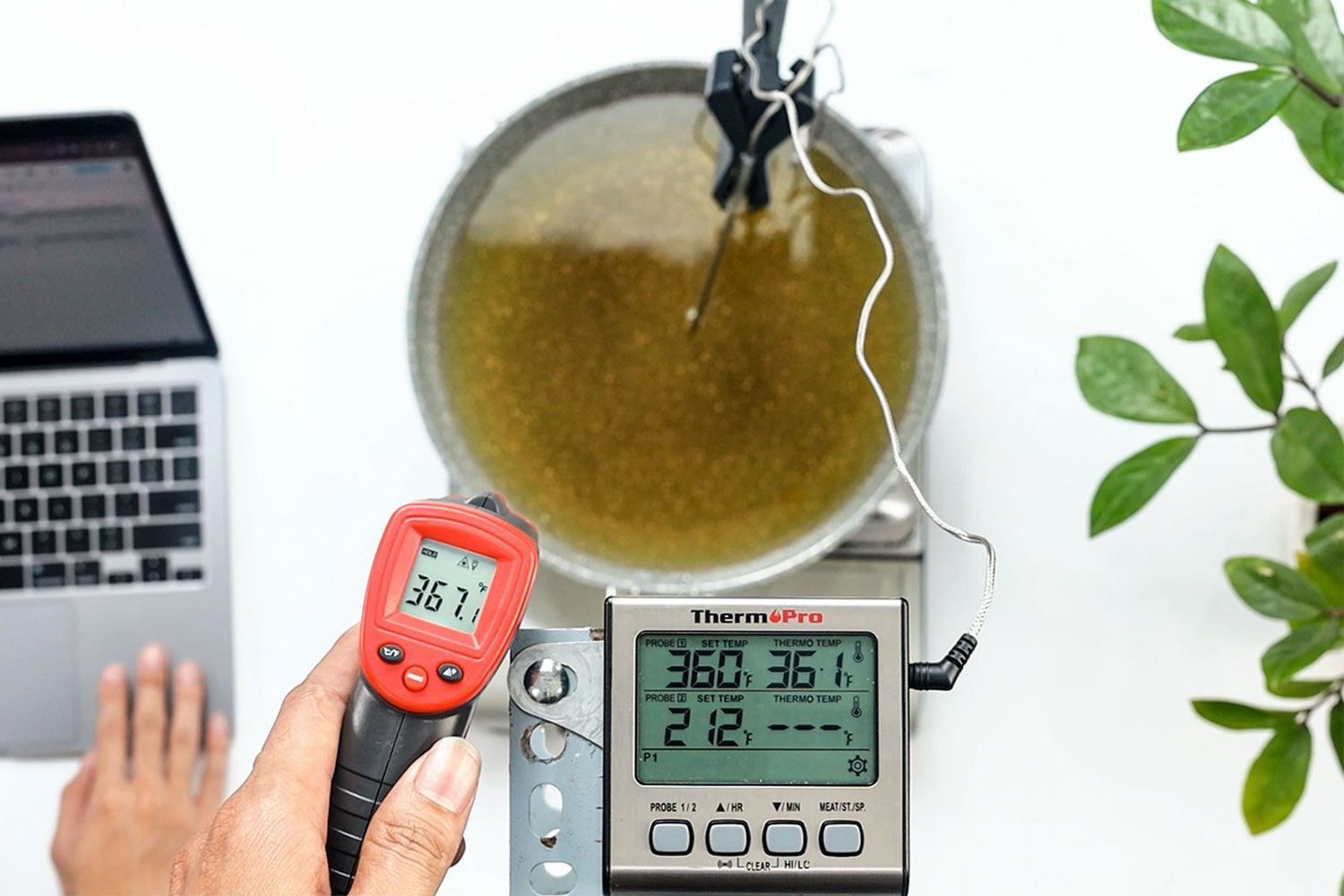
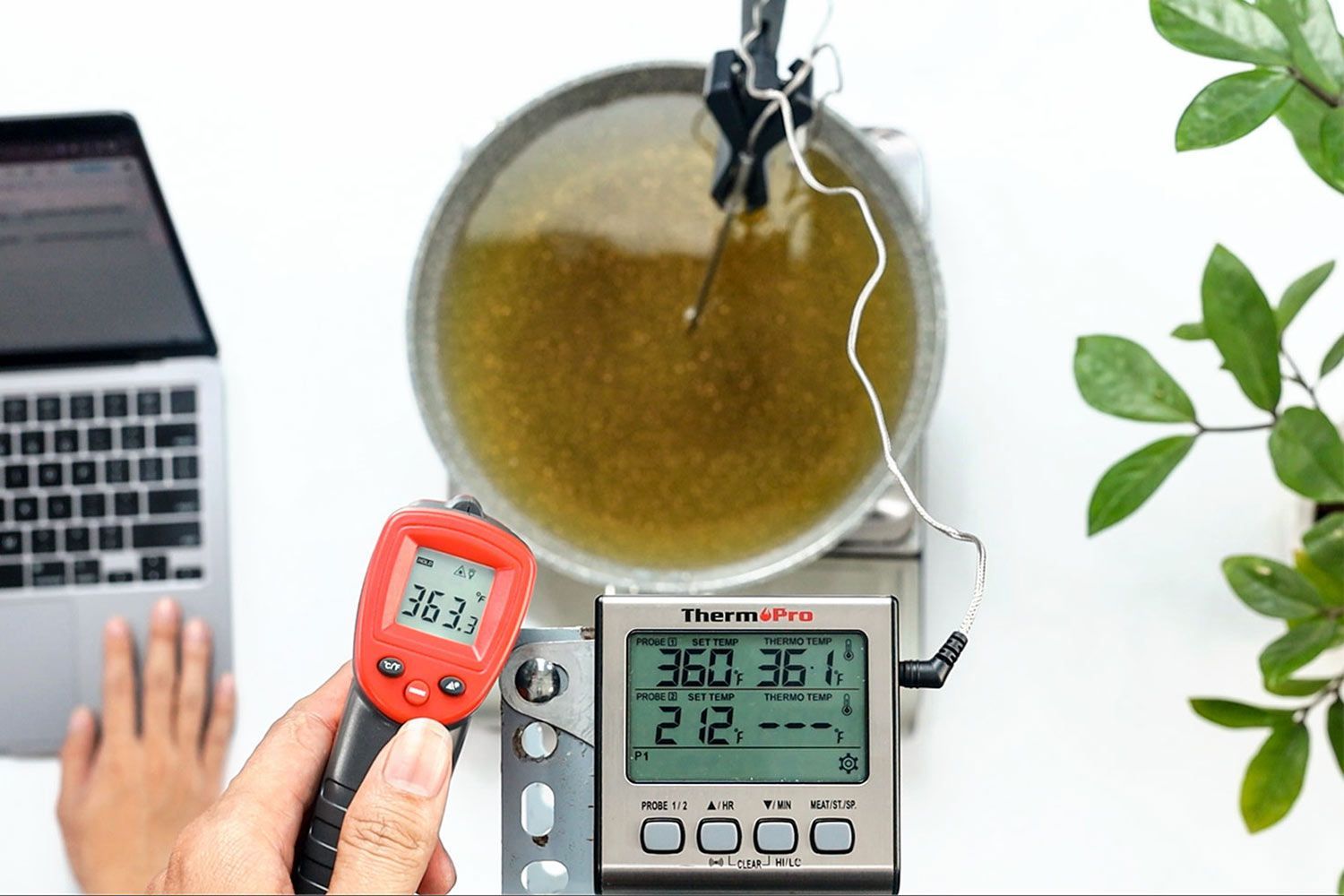
Take, for example, the Eventek GM550 IR thermometer. At 12 inches away, we got a reading of 367.1°F, and at 16 inches away, we got 363.3°F.
By calculation, the average temperature was 365.2°F, which is 2.2°F outside the 359-363°F range. As a result, the Average score is as follows:
Average = 10 - (2.2 x 0.25) = 9.45
Next, the reading difference is 3.8°F between 367.1 and 363.3°F. As such, the Stability Variable score is calculated as follows:
Stability Variable = (3.8 - 2) x 0.2 = 0.36
So overall for this test, the thermometer scores:
Overall Score = Average - Stability Variable = 9.45 - 0.36 = 9.1